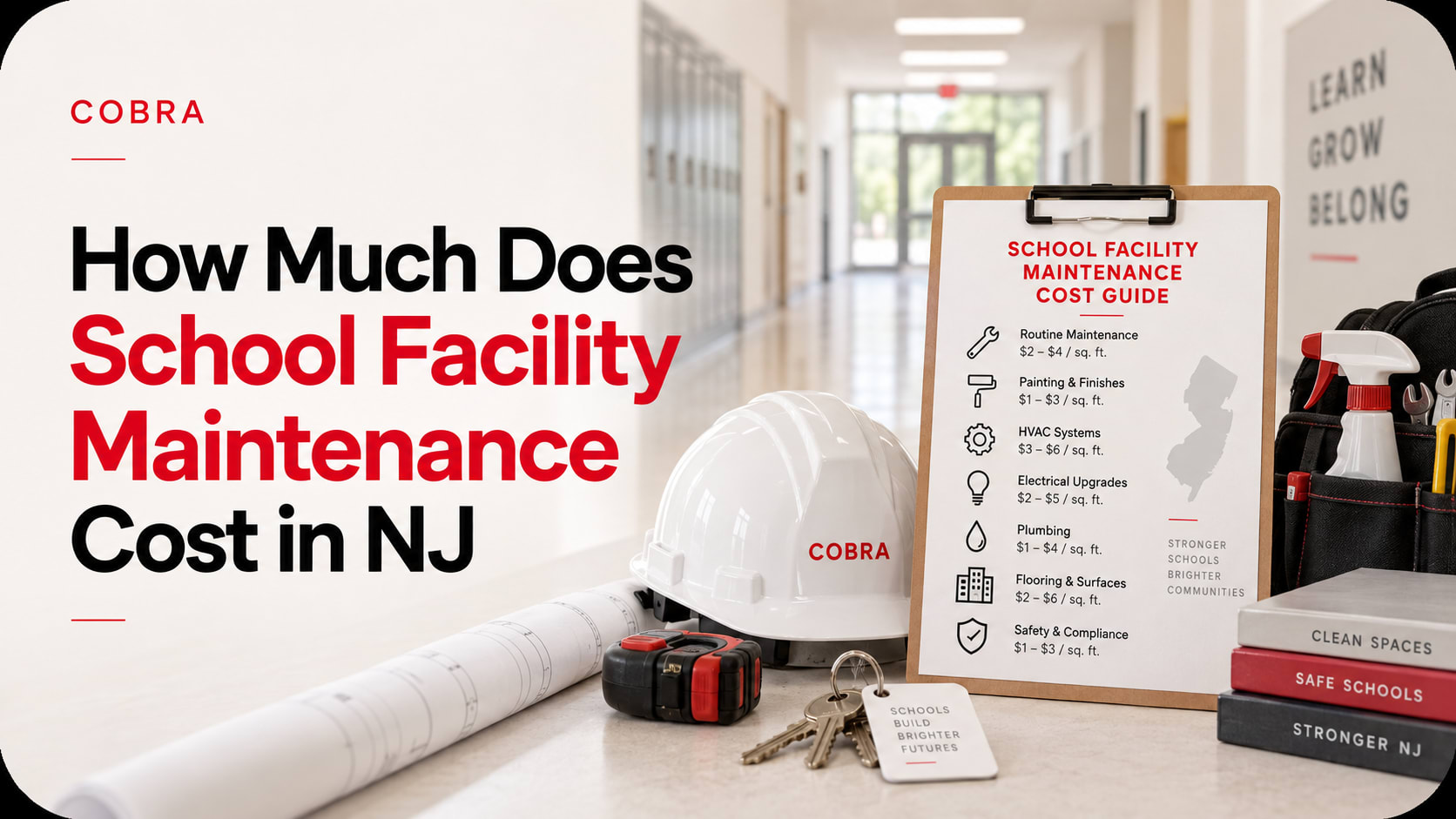
School administrators and business managers evaluating a facility maintenance contract usually start with the same question: what is this actually going to cost. The honest answer is that school facility maintenance in New Jersey does not price on a single rate card, because a K-12 campus, a private academy, and a daycare each carry a different mix of buildings, square footage, and compliance requirements. This guide walks through the factors that actually move the number, so you can scope a realistic budget before requesting quotes.
What drives the cost of school facility maintenance
A handful of factors explain most of the difference between a low quote and a high one:
Square footage and number of buildings. A single-building elementary school and a multi-building high school campus are different jobs, even at similar enrollment.
Scope of services. A contract covering only cleaning and janitorial work costs less than one that also includes security, grounds, and repair coordination.
Building age and system condition. Older HVAC, plumbing, and electrical systems need more frequent attention, which shows up in the maintenance line rather than the cleaning line.
Coverage hours. After-hours security coverage, weekend event support, and summer-only deep maintenance windows all add scope beyond a standard school-day schedule.
Number of sites. Districts consolidating maintenance across several schools under one contract typically see better per-building pricing than single-site contracts.
Why bundling services usually costs less than separate vendors
Districts that hire a separate janitorial company, a separate security firm, and a separate handyman end up paying for three sets of overhead, three invoices, and three points of contact who are not coordinating with each other. A single vendor covering security, cleaning, maintenance, and grounds under one contract removes that duplication and gives the district one number to call when something needs attention. It also means the same team is on campus consistently, rather than rotating contractors who do not know the building.
What a typical school facility scope includes
Most school facility contracts in New Jersey are built around four areas working together:
Trained security personnel for access control, visitor management, and after-hours coverage
Daily cleaning and sanitation for classrooms, restrooms, and shared spaces
Proactive maintenance and repairs, including plumbing, electrical, and general fixture upkeep
Grounds and exterior upkeep, so the campus looks presentable year-round
A district evaluating school facility services should ask any vendor to itemize which of these four areas are included and which are billed separately, since that is where quotes diverge the most.
Budgeting around the academic calendar
School facility maintenance has a seasonal rhythm that affects cost. Summer is usually when the heavier work happens, deep cleaning, floor refinishing, HVAC servicing, because the building is empty. A maintenance plan that front-loads that work into the summer window, rather than trying to do it during the school year, is usually the more cost-effective approach, since it avoids disrupting classes and reduces emergency callouts during the year.
The cost of reactive maintenance versus proactive maintenance
The biggest hidden cost in school facility budgets is not the maintenance contract itself, it is what happens without one. A district that only calls for repairs after something fails is paying for emergency response rates, unplanned disruption to classes, and often a more expensive fix than the same issue would have needed if it had been caught during a routine inspection. A leaking pipe found during a scheduled walkthrough is a repair. The same leak discovered after it has damaged a ceiling or a classroom floor is a much larger job, plus the cost of working around a space that is now out of use.
This is the practical argument for a maintenance contract over a reactive, call-when-broken approach: it is not just about convenience, it shifts spending from unpredictable emergency repairs toward planned, budgeted work, which is easier for a business manager to forecast year over year.
Questions to ask before signing a contract
Before comparing final numbers, districts should get clear answers to a few questions from any vendor: Is the quote based on an actual walkthrough of the campus, or a general estimate? Which of the four core areas, security, cleaning, maintenance, and grounds, are included versus billed separately? What is the response time for non-emergency repair requests during the school year? And how is summer or break-period work scheduled and communicated to the district in advance? A vendor who can answer all four clearly is generally easier to budget around than one who gives vague answers to keep the initial number low.
Frequently Asked Questions
What is included in a school facility maintenance contract?
It depends on the scope you request, but most contracts combine some mix of security, cleaning and sanitation, proactive maintenance and repairs, and grounds and exterior upkeep. A vendor should be able to itemize each of these separately so you know exactly what you are paying for.
Is it cheaper to hire one vendor instead of separate companies for security, cleaning, and repairs?
Usually, because a single vendor spreads overhead across the whole contract instead of billing it three separate times, and it removes the coordination gaps that show up when three companies are not talking to each other.
Does school facility maintenance cost more for older buildings?
Generally yes. Older HVAC, plumbing, and electrical systems require more frequent attention, and that shows up as additional maintenance work rather than as a separate line item.
Can maintenance work be scheduled around the school year?
Yes, and it typically should be. Heavier work like deep cleaning and system servicing is usually scheduled for summer or school breaks specifically to avoid disrupting classes.
How do I get an accurate quote for my school or district?
The most accurate quotes come from a walkthrough of your specific campus, since square footage, building count, and current system condition all affect the number more than any general estimate can.
For a closer look at what a facility contract typically includes across security, cleaning, and repairs, see our guide to school facility maintenance services in NJ.