
Every New Jersey school district has to answer the same operational question at some point: what does a school actually need to have in place for security, beyond hiring a guard and hoping for the best. The answer is less about any single product and more about a small number of layers working together, consistently, every day. This guide covers what districts and private schools typically need to have covered, and where the gaps usually show up.
The core layers of school security
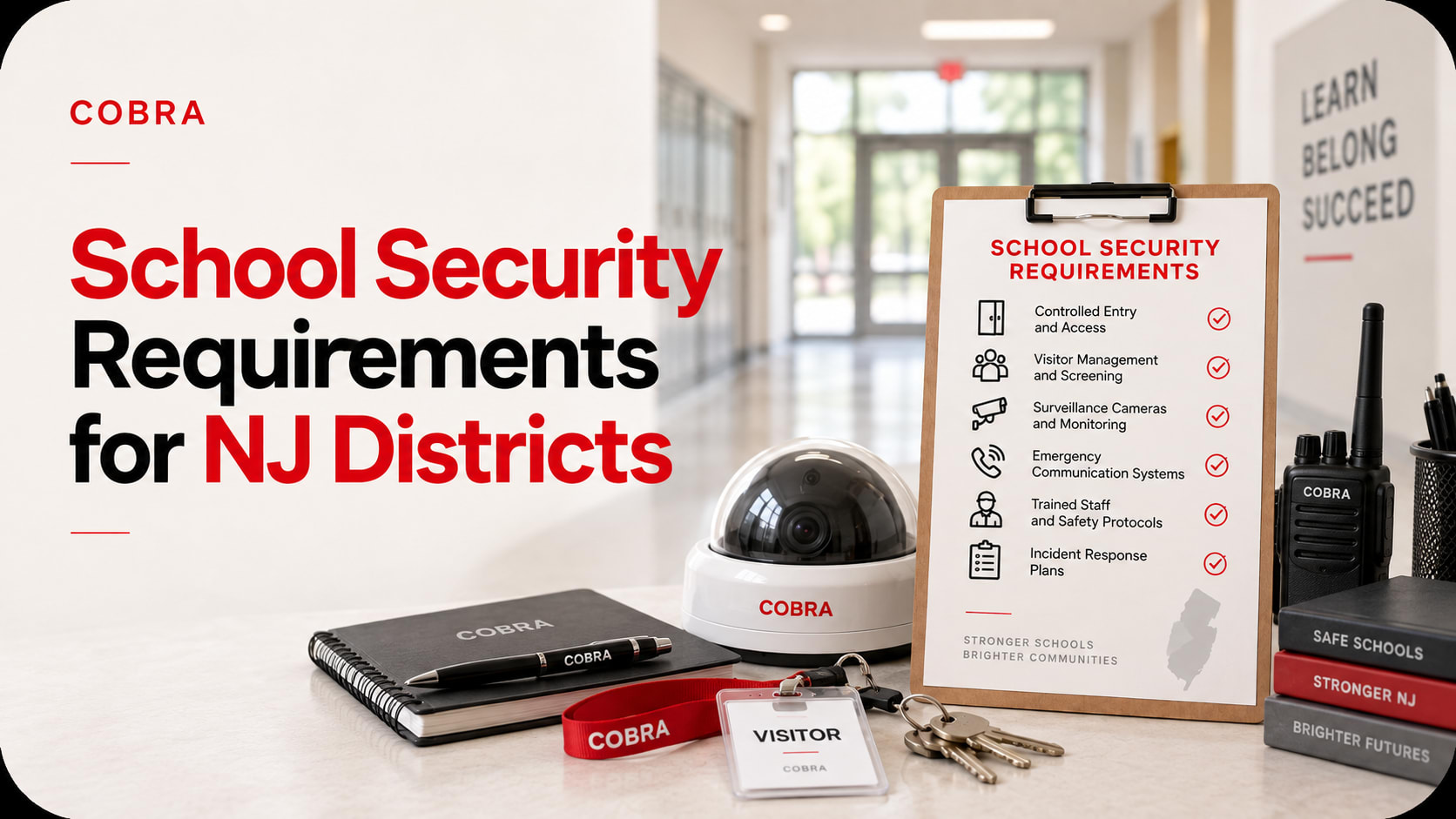
Most workable school security programs are built around the same core pieces, whether the campus is a single building or a multi-building district:
Controlled entry and access. A school should know who is in the building at any given time, which means managed entry points rather than open doors during the day.
Visitor management and screening. Every visitor should be logged and identified before they reach classrooms, not just at a front desk that anyone can walk past.
Surveillance and monitoring. Cameras covering entrances, hallways, and the perimeter, actively monitored rather than just recording to a drive no one checks.
Emergency communication systems. A way to alert staff and, when needed, first responders quickly, that does not depend on one person's cell phone.
Trained staff and safety protocols. Security personnel who are trained specifically for a school environment, not repurposed retail or event security.
Incident response plans. A documented plan for lockdowns, medical emergencies, and after-hours incidents that staff have actually practiced.
Where school security programs typically fall short
The most common gap is not the absence of a security guard, it is inconsistency. A single officer without backup coverage, cameras that are not actively monitored, or visitor logs that are not enforced during busy drop-off and pickup windows all create the same problem: a policy that exists on paper but is not reliable in practice. A school security program is only as strong as its weakest daily habit, which is why staff training and consistent enforcement matter as much as the equipment itself.
Unarmed security personnel in a school setting
Most New Jersey schools use trained unarmed security personnel rather than armed officers, covering campus access control and monitoring, visitor management and ID checks, hallway and perimeter patrols, and after-hours coverage for events and evening activities. The training difference matters here: a school environment calls for a different approach than a commercial building or retail site, since the priority is de-escalation and coordination with staff and administration, not just a visible presence.
How this fits into a broader facility plan
Security rarely sits in isolation from the rest of facility operations. A district evaluating school facility services is usually also thinking about cleaning, maintenance, and grounds, and there is a real advantage to having security coordinated with the same team handling the rest of the building, since incident reporting, access issues, and facility condition are often connected in practice even if they are budgeted separately.
How to evaluate a school security vendor
Not every security company is set up to work in a school environment, and the difference matters more than it does for a typical commercial contract. When evaluating a vendor, districts should ask specifically about experience in school settings rather than general commercial or retail security, since the priorities are different: de-escalation, working alongside teachers and administrators, and understanding the daily rhythm of drop-off, class changes, and dismissal.
It is also worth asking how the vendor handles coverage gaps, what happens when a scheduled officer calls out, whether there is a backup plan, and how quickly a replacement can be on site. A security program that looks solid on the org chart but has no answer for a callout is not actually reliable day to day. Finally, ask how incidents are documented and communicated to administration, since a security team that cannot produce clear reporting after an incident makes it harder for the district to respond appropriately or adjust policy over time.
Building security into the rest of campus operations
Security works best when it is not treated as a separate silo from the rest of facility operations. Front desk staff, teachers, and security personnel all notice different things, an unfamiliar face in a hallway, a propped-open door, a maintenance issue near an exit, and a program that has a clear way to route those observations to the right person catches more than a security team working in isolation. Districts that coordinate security with their broader facility plan tend to close these gaps faster than those managing it as a completely separate function.
Frequently Asked Questions
What security measures are required for NJ schools?
There is no single checklist that applies to every district, but most schools need controlled entry, visitor screening, monitored surveillance, an emergency communication system, trained staff, and a documented incident response plan.
Do NJ schools need armed or unarmed security guards?
Most New Jersey schools use trained unarmed security personnel for day-to-day access control, visitor management, and patrols. The right choice depends on the district's own risk assessment and policy.
What is the most common security gap in schools?
Inconsistency, not absence. A camera system that is not actively monitored, or a visitor policy that is not enforced during busy periods, creates the same exposure as having no system at all.
Should security be coordinated with facility maintenance?
It helps. Access issues, incident reporting, and facility condition are often connected, and having one team handle both means problems get caught and communicated faster.
How often should a school's security plan be reviewed?
At minimum once a year, and after any incident or significant change to the building, enrollment, or schedule.
For the maintenance and facility side of running a campus, see our guide to school facility maintenance services in NJ.