Understaffing security leaves real gaps in coverage. Overstaffing wastes budget on redundant coverage. Getting the number right depends on a handful of concrete factors specific to the property, not a generic rule of thumb that applies everywhere.
Headcount is only one variable, how those guards are deployed matters just as much, see our guide to mobile patrol vs. stationary security guards.
Fire watch coverage is a specialized case of this same staffing question, see our guide to fire watch services cost in New Jersey for how that pricing works.
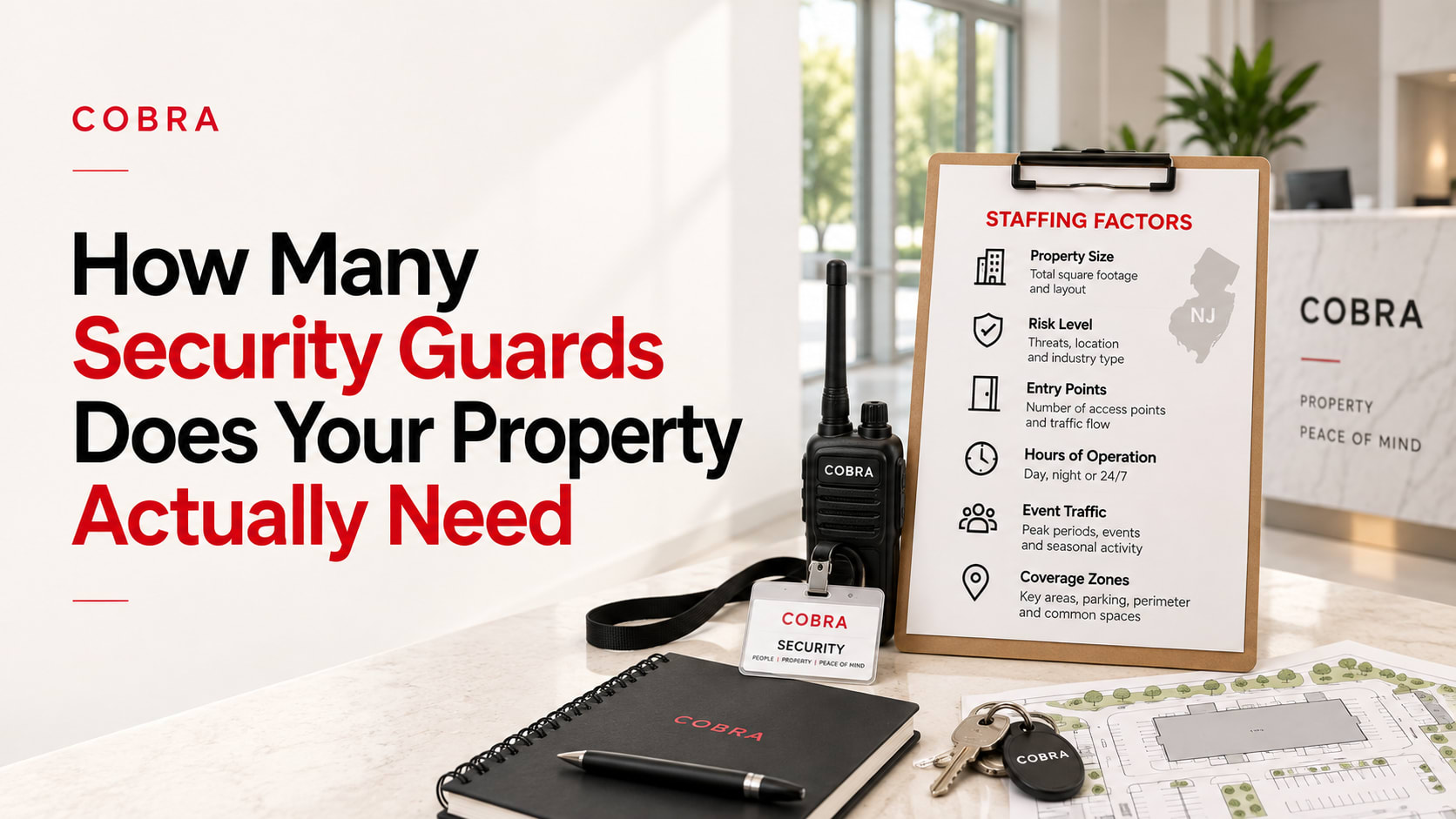
The core staffing factors
Property size. Total square footage and layout directly affect how much ground one guard can realistically cover.
Risk level. Threats, location, and industry type all shift how much coverage a property genuinely needs.
Entry points. The number of access points and how much traffic flows through each one.
Hours of operation. Day, night, or 24/7 coverage each require a different staffing plan.
Event traffic. Peak periods, scheduled events, and seasonal activity that temporarily increase the coverage needed.
Coverage zones. Key areas, parking, perimeter, and common spaces that each need attention.
Why property size alone doesn't determine staffing
Two properties of similar square footage can have very different staffing needs depending on layout. A single open floor is easier to monitor than a property with multiple buildings, blind corners, or a sprawling parking area. Staffing decisions should be based on an actual walkthrough of the property, not just a number on a floor plan.
Matching coverage to entry points
Every additional entry point is a place someone needs to be watching, whether through personnel or camera coverage. A property with a single controlled entrance needs far less staffing than one with multiple unmonitored access points. Reducing the number of active entry points is sometimes a more cost-effective solution than adding more guards to cover all of them.
Why hours of operation change the calculation
A property that only needs coverage during business hours has very different staffing needs than one requiring 24/7 presence. Overnight coverage in particular often gets underestimated, since lower visible activity doesn't mean lower risk, it can mean the opposite, since fewer people are around to notice something happening.
Planning for peak periods separately from baseline staffing
A property's normal staffing level often isn't enough during a scheduled event, holiday season, or unusually high-traffic period. Rather than permanently overstaffing to cover occasional peaks, a better approach is a flexible plan that scales up temporarily for known high-traffic periods and returns to baseline otherwise.
Getting an accurate staffing recommendation
The only reliable way to determine the right number of guards is a site assessment that accounts for layout, entry points, hours, and risk level together, not any single factor in isolation. A vendor who proposes a staffing number without walking the property first is guessing, not assessing.
Staffing count is closely tied to what those guards are actually authorized to do, see our guide to unarmed security guards for that distinction.
Frequently Asked Questions
Does a bigger property automatically need more security guards?
Not necessarily. Layout matters as much as square footage, a property with multiple blind spots needs more coverage than an equally sized property with open sightlines.
How do entry points affect staffing needs?
Every active entry point needs to be monitored, whether by personnel or camera. Reducing unnecessary entry points can sometimes reduce staffing needs more efficiently than adding guards.
Is overnight security staffing usually underestimated?
Often, yes. Lower visible activity at night doesn't mean lower risk, and can mean the opposite since fewer people are present to notice an issue.
Should staffing increase for events or peak seasons?
Yes, temporarily. A flexible plan that scales up for known high-traffic periods is usually more cost-effective than permanently overstaffing.
How is the right number of guards actually determined?
Through a site assessment that considers layout, entry points, hours of operation, and risk level together, not a generic formula.
For the full range of security coverage available, see our guide to security services in New Jersey.